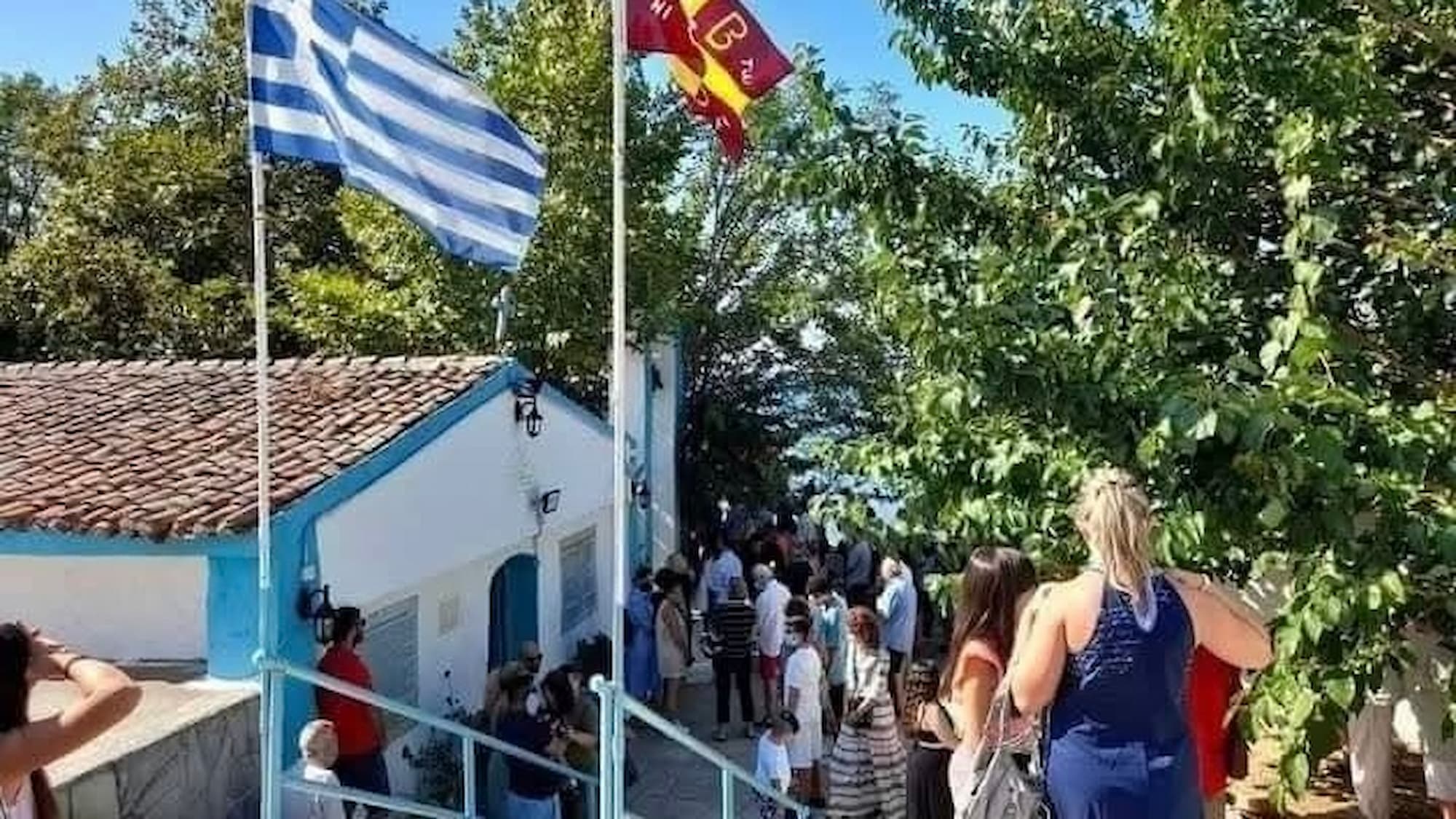
Have you noticed how many villages in Halkidiki and in Greece in general start with Nea? This translates to New, and there is a good reason behind it. But not always! In this article we focus on Halkidiki's fishers' spot, the very bottom village of Kassandra peninsula.
Nea Skioni might not be the first village in mind when someone thinks of Halkidiki. It's far away from the city, and perhaps not as advertised as the rest. This has prevented Nea Skioni from converting in a tourist destination, and preserves a character that has been present for many decades.
My connection to Nea Skioni comes in three forms. The first has to do with food, as always! Nea Skioni has a natural port, in which most fishers, small- and large-scale are spending the night after a long shift in the Aegean sea. There I have met fishers who invited me for lunch and tsipouro, and talked about life, hardship, and of course...the sea!
The second form of connection comes through the summer camp I used to go when i was little. It's called "Once upon a time" (Μια φορά κι έναν καιρό), and is a thematic summer camp for folklore life and Greek tradition. Ms Dimitra, the owner is a proud woman from Nea Skioni that wanted all children to learn how to bake bread, how to take care of goats, and do the "threshing" (as google translated from "αλώνι") during the process in which the horse is crushing the wheat to separate it. I've been going to this summer camp for years, and I recognise its contribution to my connection to Halkidiki and my cultural heritage.
The third form of connection is less positive, yet the most sentimental of all. In 2006, a massive wildfire burnt the middle peninsula (from Polichrono and all the way south). For three whole days the fire kept on burning every single trunk of tree, leaving naked burnt tree bodies behind, homeless people, and the feeling of disaster. As a 6-year-old girl, I couldn't believe how traumatising the loss of our forest was. My most intense memory: driving through the forest of Nea Skioni and feeling empty inside. Thankfully, 20 years later and the forest has recovered and is now blooming with life.
But let's get back to Nea Skioni village. Here are some words written by Timoleon Makrygiannis, a professor in Aristotle University of Thessaloniki.
And the name of the village is NEA SKIONI, not simply SKIONI...
As is well known, almost all refugee villages have the prefix ‘NEA’ before their name. For example, NEA MOUDANIA, NEA FOKAIA, etc. So is the present-day village of NEA SKIONI a refugee village, yes or no? The answer is no. There is a story behind this.
Ancient Skioni, later known as Tsaprani, was not built by the sea but within the adjacent mountain, some 8 kilometres from the coast. The inhabitants of Tsaprani were also involved in fishing and, naturally, owned land on the coast. Around 1918, they began to move down to the coast. By 1931, almost all of them had moved, thus establishing Neo Tsaprani.
The first settlers on the Tsaprani coast were two brothers from the village of Adrameri in Chalkidiki. These two brothers worked as charcoal burners in the neighbouring Anastasitiko Metochi. They arrived at Tsapranio beach around 1884. They happened to meet a shepherd, Angelos Drepás.
As soon as he saw them, he said:
Hello there, lads. Where are you from and what are you doing in these parts?’ They replied: ‘
We’re from Adrameri and we make charcoal at Anastasitiko Metochi. We’ve taken a fancy to Kassandra and we want to find a spot, buy it and build a little house so we can live here permanently.’ And he replied:
-‘Here’s this plot of land, from the sea up to the grove above — about a hectare — it’s mine. If you give me 5 liras, I’ll give it to you.’
‘Yes, we’ll take it, grandad, but we don’t have all the money right now. We’ll give you 3 pounds, and the other 2 after Easter, when we go to the village to celebrate Easter with our families.’ And old Mr Drepás replied:
‘Yes, my children, just give me 1 pound now, and the rest after Easter.’ And so it came to pass.
After Easter, the people of Adrameri paid the remaining four pounds to the old man and began to build their little house, which they soon finished. They then bought more fields and olive groves, had many children, and thus became prominent landowners; the area came to be known as ‘Adrameriana’. The people of Tsaprani, seeing that the people of Adrameria were living better than they were on the coast, gradually began to leave the village and settle on the coast of their own village. Thus, the new village on the beach grew, but it had neither a church nor a school.
**This is the story of how Nea Skioni was born. **
If you happen to pass by, let it be on January 6th. The village is preparing an impressive "Theofania" (Θεοφάνεια) in which a large group of people dives in the cold waters to catch the holy cross that is being thrown by a priest on a boat. Very impressive, and equally matching with a nice fish lunch later on.